> For the complete documentation index, see [llms.txt](https://bleepy.gitbook.io/bleepy-developers/llms.txt). Markdown versions of documentation pages are available by appending `.md` to page URLs; this page is available as [Markdown](https://bleepy.gitbook.io/bleepy-developers/game-promotion/react-native.md).
# React Native
***
## 1단계: react-navigation 라이브러리 설치
스크린 이동을 위해 `react-navigation` 패키지를 설치합니다.
```sh
npm install @react-navigation/native
```
해당 가이드는 `Native Stack Navigator`를 사용합니다.
```sh
npm install @react-navigation/native-stack
```
위 라이브러리와 의존성(dependencies)을 가지는 추가 라이브러리 설치가 필요합니다.
```sh
npm install react-native-screens react-native-safe-area-context
```
iOS의 경우 [\[Cocoapods\]](https://cocoapods.org/) 를 통해 `Pod` 설치가 필요합니다.
```sh
npx pod-install ios
```
***
## 2단계: 런처 스크린 화면 구성
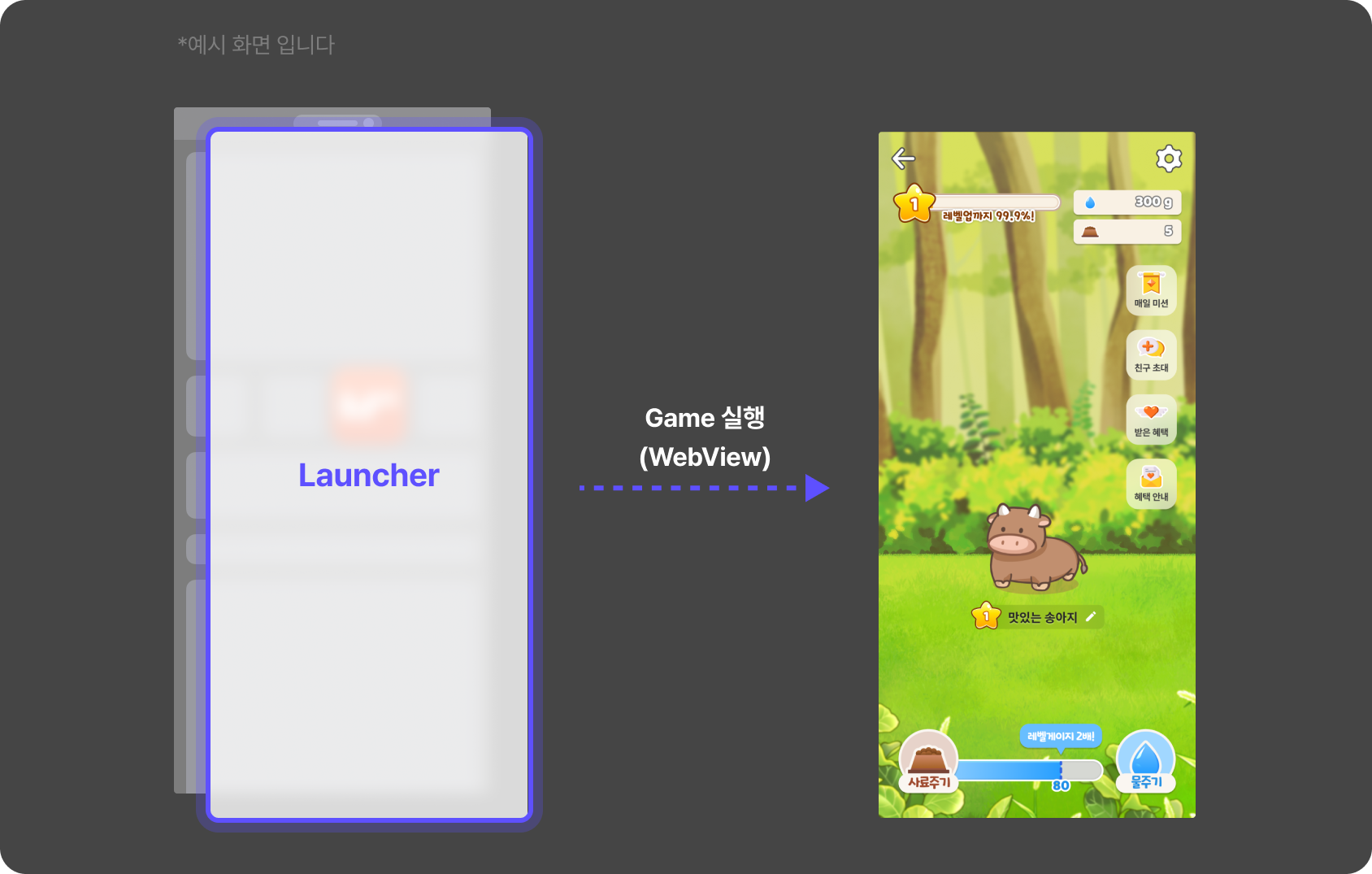
자사 서비스 내 인앱 게임을 구동하기 위해서는 `WebView` 를 포함하는 스크린의 생성이 필요합니다.\
다음 가이드를 따라 진행 해주시기 바랍니다.
### 1. 런처 스크린 파일 생성
`src/screens` 경로에 런처용 스크린 화면을 추가합니다. \
예시로 `src/screens/launcher/Launcher.tsx` 로 작성하였습니다.
### 2. Navigation 라우팅 추가
`App.tsx` 파일에서 `Navigator` 관련 정의를 추가합니다.\ `Stack Navigator`에 하위로 사용할 스크린에 해당하는 `Stack`을 생성합니다. \ `Stack.Screen` 의 `name` 값이 라우팅 경로가 되고, `component` 는 스크린 컴포넌트를 넣어주세요.
예시 가이드에서는 `launcher` , `banner` 2가지 스크린을 사용하였습니다.
```typescript
// App.tsx
import {NavigationContainer} from '@react-navigation/native';
import {createNativeStackNavigator} from '@react-navigation/native-stack';
import HomeScreen from '@screens/home';
import LauncherScreen from '@screens/launcher';
const Stack = createNativeStackNavigator();
export type RootStackParam = {
launcher: undefined;
banner: {url: string};
};
export default function App() {
return (
);
}
```
### 3. WebView에 런처 호출 URL 로드
`WebView` 를 사용하기 위해서 `react-native-webview` NPM 라이브러리를 설치 합니다.
```sh
npm i react-native-webview
```
런처 스크린 내에 `WebView` 컴포넌트를 추가하고 `source` 속성에 `런처 호출 URL`을 요청합니다.
* 자바스크립트 활성화를 위해 `javaScriptEnabled` 값을 `true` 로 설정합니다.
* iOS는 메모리 문제로 `Terminate` 발생 가능성이 있어 `reload` 처리를 추가적으로 권장합니다.
* `WebView` 관련 `ref` 선언을 추가합니다.
* `WebView` 컴포넌트 내 `onContentProcessDidTerminate` 콜백을 통해 `reload` 처리합니다.
```typescript
// src/screens/launcher/Launcher.tsx
import { WebView } from 'react-native-webview';
import { useRef } from 'react';
export default function Launcher() {
const webviewRef = useRef();
...
return (
...
{
// webview reload
webviewRef.current?.reload();
}}
javaScriptEnabled={true}
/>
...
)
}
```
***
## 3단계: onMessage 설정 추가
런처와 React Native간의 통신을 수행하기 위해 `WebView` 의 `onMessage` 콜백을 정의합니다. \ `WebView` 에 로드된 런처에서 React Native로 메세지 이벤트를 전달합니다.\
다음은 런처에서 전달하는 이벤트 케이스 입니다.
Type
Description
closeLauncher
런처의 Back 버튼 UI 클릭 시 (뒤로가기 처리)
launcherLoaded
런처 로드가 완료된 시점에 호출
timerMissionComplete
타이머 미션이 완료 되었을 때 호출
giftReceived
육성완료 시 호출
```typescript
// src/screens/launcher/Launcher.tsx
import {WebView, WebViewMessageEvent} from 'react-native-webview';
export default function Launcher() {
// WebView에서 보내온 메세지 처리
const onMessage = (e: WebViewMessageEvent) => {
const {type, inviteCode, infoMessage, link}
= JSON.parse(e.nativeEvent.data);
switch (type) {
case 'closeLauncher':
closeLauncher();
break;
case 'launcherLoaded':
launcherLoaded();
break;
case 'timerMissionComplete':
timerMissionComplete();
break;
case 'giftReceived':
giftReceived();
break;
}
};
return (
);
}
```
```typescript
// src/screens/launcher/Launcher.tsx
// 런처 종료 - 블리피 런처의 Back 버튼 UI 클릭 시 React Native에서는 뒤로가기 처리를 수행합니다.
const closeLauncher = () => {
if (navigation.canGoBack()) {
navigation.goBack();
}
};
// 런처 로드 완료
const launcherLoaded = () => {
// 런처의 로드가 완료된 후 추가적인 처리 필요 시 사용
};
// 타이머 미션 완료
const timerMissionComplete = () => {
// 타이머 미션 완료 후 추가적인 처리 필요 시 사용
};
// 육성완료
const giftReceived = () => {
// 육성완료 후 추가적인 처리 필요 시 사용
};
```
***
## 4단계: 런처 스크린 세로모드 고정
게임은 세로모드 해상도에 최적화 되어 스크린의 세로모드 고정이 필요합니다.\
세로모드 고정을 위해 `react-native-orientation-locker` 라이브러리를 설치합니다.
```sh
npm install --save react-native-orientation-locker
```
* 세로모드 고정 코드를 추가합니다.
```typescript
// 추가
import Orientation from 'react-native-orientation-locker';
export default function Launcher() {
...
// 추가
useEffect(() => {
// 화면 방향을 세로로 고정합니다.
Orientation.lockToPortrait();
return () => {
// clean-up에서 다른 스크린에 영향 없도록 Orientations 해제
Orientation.unlockAllOrientations();
};
}, []);
return (
);
}
```
* iOS 환경에서는 추가 설정이 필요합니다.
* `/ios/AppDelegate.m` 파일을 열고 아래 코드를 추가합니다.
* `pod install` 실행합니다.
```objectivec
// AppDelegate.m or AppDelegate.mm
// 추가
#import "Orientation.h"
@implementation AppDelegate
...
// 추가
- (UIInterfaceOrientationMask)application:(UIApplication *)application supportedInterfaceOrientationsForWindow:(UIWindow *)window {
return [Orientation getOrientation];
}
...
@end
```
***
## 5단계: 화면 전환 설정
### 1. 딥링킹을 위한 설정 추가
React Native 환경 내 `Android` / `iOS` 두 플랫폼에서 딥링킹 처리를 위한 가이드입니다.
#### `Android`
* 프로젝트 루트 경로 내 `android/app/src/main/AndroidManifest.xml` 파일 내 딥링킹 처리를 위한 `intent-filter` 를 추가합니다.
* `scheme` 값은 프로모션 설정 시 입력할 딥링크에 사용하실 스키마 값으로 세팅해주세요.
```xml
// android/app/src/main/AndroidManifest.xml
```
***
#### `iOS`
`scheme` 관련 정보는 `직접 코드 추가` 또는 `Xcode 내 설정`하는 2가지 방법이 있습니다.
* 직접 코드 추가
* `info.plist` 파일에 직접 코드를 추가합니다.
* `CFBundleURLTypes` 관련 내용을 아래와 같이 추가합니다.
```xml
...
CFBundleURLTypesCFBundleTypeRoleEditorCFBundleURLName{식별자(scheme와 동일하게 세팅해도 무관)}CFBundleURLSchemes{사용할 scheme}
...
```
* Xcode 내 설정
* URL Types에 `scheme` 추가합니다.
프로젝트 `/ios` 경로 내에 몇가지 설정을 더 추가합니다.
```objectivec
// ios/프로젝트명/AppDelegate.mm
// 파일 상단에 추가
#import
...
// @end위에 추가
- (BOOL)application:(UIApplication *)application
openURL:(NSURL *)url
options:(NSDictionary *)options
{
return [RCTLinkingManager application:application openURL:url options:options];
}
...
@end
```
***
### 2. NavigationContainer linking 추가
React Native에서는 `NavigationContainer` 의 `linking` 기능을 사용하여 딥링크를 컨트롤합니다.
```typescript
// App.tsx
export default function App() {
// 사용할 scheme, host를 통해 이동할 screen을 지정
const linking = {
prefixes: ['{scheme}://'],
screens: {
{host}: 'screenName',
},
};
return (
// linking set
...
);
}
```
{% hint style="info" %}
개발에 대한 추가 설명이 더 필요하신가요?
"[\[Client Admin\]](https://client-admin.bleepy.io/login) 로그인 → 오른쪽 하단 채널톡 위젯" 클릭 후 개발 카테고리에 문의 남겨주시면 기술 개발팀에서 확인 후 연락드리겠습니다.
{% endhint %}